



"Incontri d'Arte" is a series of traveling exhibitions along the Via Claudia Augusta. At each edition of Incontri d'Arte, artists from the regions located along the historic road contribute one work of art each, created around a common theme. The traveling exhibition demonstrates that the Via Claudia Augusta not only boasts a fascinating cultural history but is also a vibrant and relevant cultural axis spanning Europe, eager to pass on to future generations a cultural heritage even richer than that inherited from our ancestors. At “Incontri d’Arte,” cultures, artists, works of art, regions, artistic movements, and interesting people come together... Come join us!
Traveling Exhibition Series
Incontri D'Arte
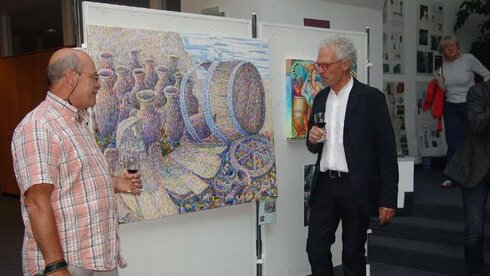
Second edition on the topic of “The Barrel”
3rd Edition
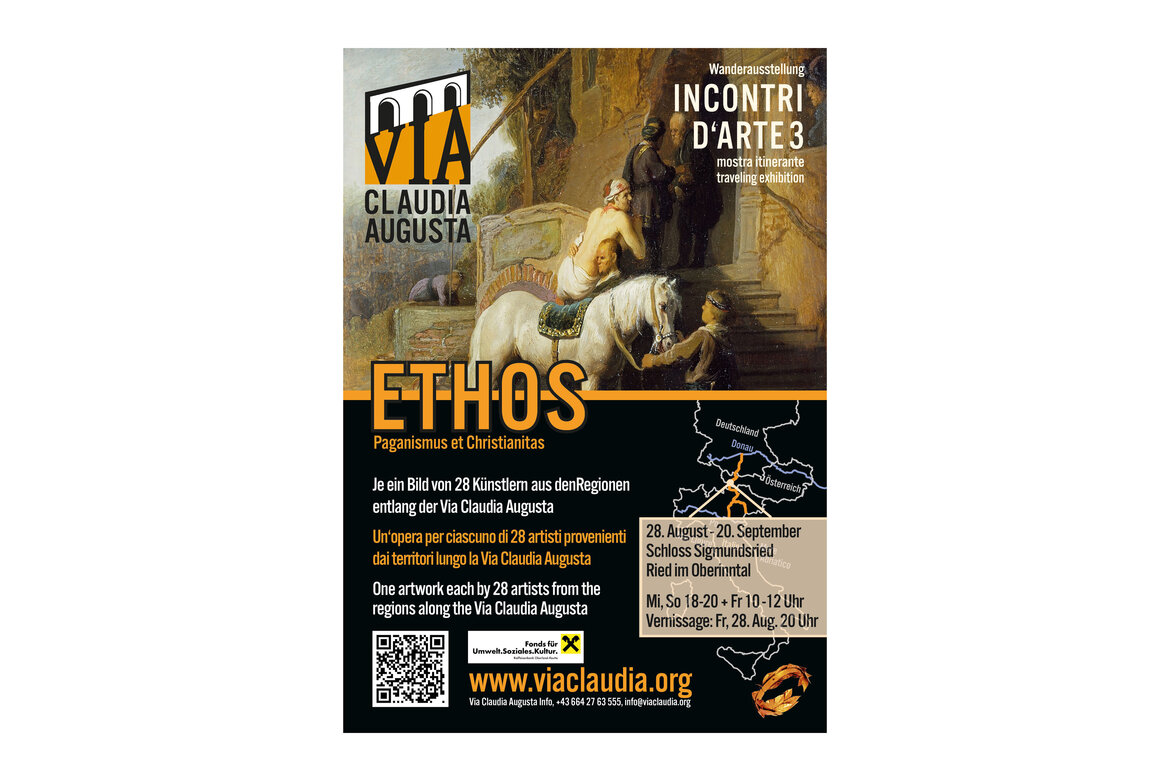
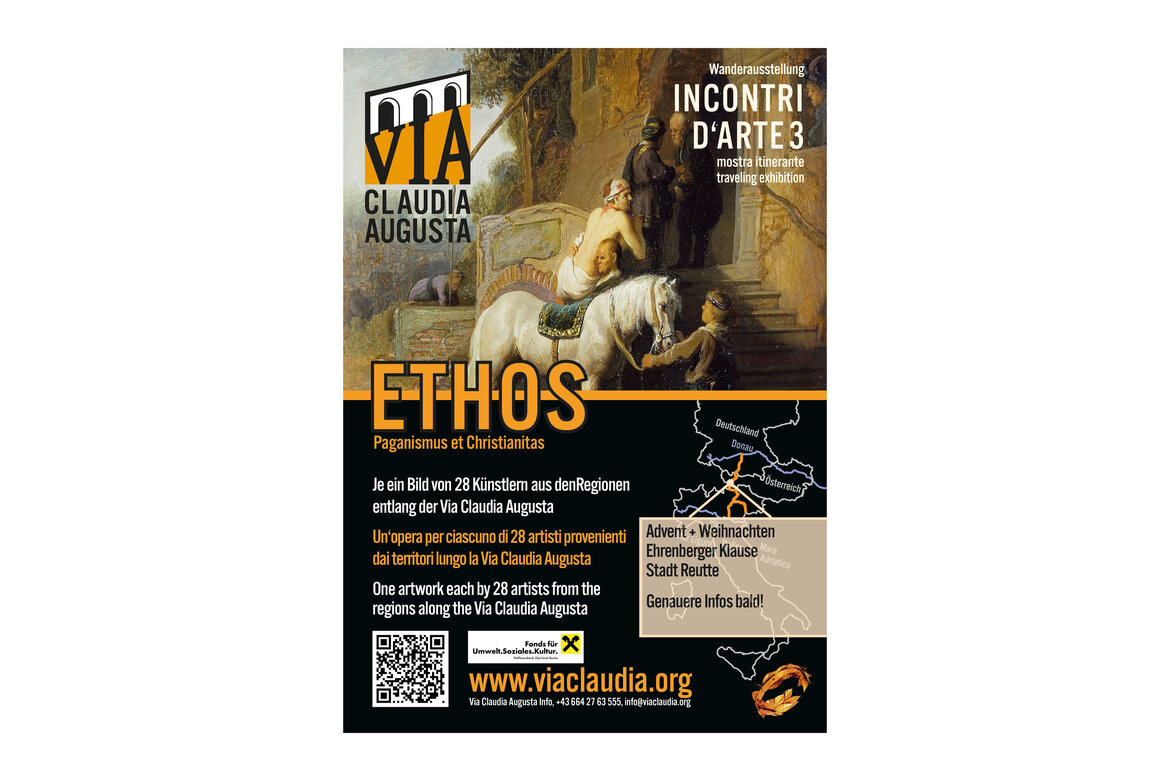
ETHOS
Paganismus et Christianitas
Next stops on the
traveling exhibition along the
Via Claudia Augusta
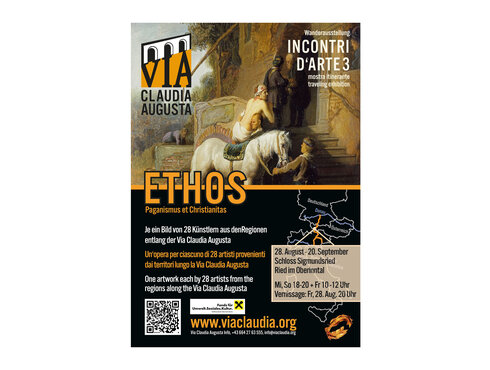
The Topic
"ETHOS, PAGANISMUS ET CHRISTIANITAS"
(Greek and Latin)
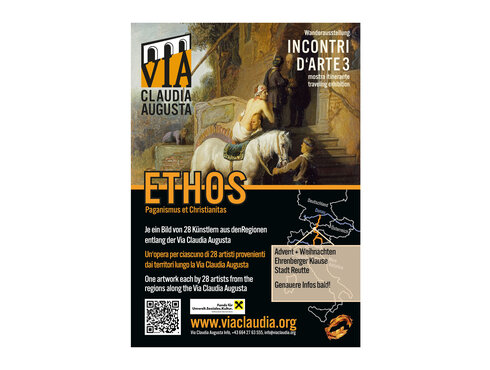
The road that the Romans built and named the Via Claudia Augusta has been an important route connecting Europe for thousands of years. Encounters and exchanges with people from many different lands shaped individuals, regions, and their cultures. Christianity also spread via roads such as the Via Claudia Augusta. This is evidenced, among other things, by the remains of a 5th-century church beneath St. Lawrence’s Church in Imst and a church beneath Augsburg Cathedral dating from the late 4th/early 5th century. Just as the Via Claudia Augusta brought people together and fostered their exchange, the traveling exhibition Incontri D’arte (Art Encounters) is bringing together artists, works of art, and art enthusiasts from all regions along the Via Claudia Augusta for the third time. Each edition of the traveling exhibition, initiated by the Cooperative Dirò in Mezzocorona, is dedicated to one of the many influences and ideas that the historic road has brought over thousands of years. If we ask what new insights the Via Claudia Augusta has brought us regarding Christianity, the answers can be summarized under the overarching theme of “ethos.” In the third edition of the traveling exhibition, we ask ourselves whether ethos really played a lesser role before the advent of Christianity, whether the Via Claudia Augusta brought more ethos with Christianity, and how ethical we are today. Artists from the regions along the Via Claudia Augusta have also addressed this question and offer us food for thought and inspiration for exciting discussions at the Incontri d’Arte.
The exhibition on the topic of
"ETHOS, PAGANISMUS ET CHRISTIANITAS",
what awaits those interested
What guides our actions? What do we mean by responsibility, justice, compassion, or the common good—and where do our ideas about how we should live together come from?
The third edition of the traveling exhibition INCONTRI D’ARTE brings together artists from the regions along the Via Claudia Augusta for a multifaceted exploration of ETHOS. The starting point is the historic cultural route itself: over the course of millennia, it served as a meeting place for people and cultures, a conduit for the exchange of goods and knowledge, and a pathway for the spread of religious and social ideas. With the advent of Christianity, new, increasingly broadly defined ethical principles also made their way into the regions of Europe along these routes.
However, the exhibition does not treat this development as a closed historical narrative, but rather as a starting point for questions. After all, concepts of right conduct existed long before Christianity. In the works on display, ancient deities and figures from tradition represent, for example, justice and order, reliability and moderation, honesty and trust, the responsible use of power, or the application of personal strength for the common good. Christian motifs, in turn, address themes of care, community, protection, and responsibility. Thus, different cultural traditions converge in the exhibition without the ethos being unambiguously attributable to a single era or religion.
Other artists detach the question entirely from historical symbols and turn their focus to people of the present. They explore people on the margins of society, the relationship between “I” and “you,” responsibility toward others, community and faith, law and justice, and the transmission of shared values to future generations. In this context, ethos does not appear as a fixed catalog of moral rules, but as something that must continually prove itself anew through concrete action.
The artistic approaches are correspondingly diverse. Figurative and abstract painting, drawing, collage, and other forms of expression coexist. Some works make direct, socially critical arguments, while others work with symbols, historical references, or personal experiences. Some articulate convictions, while others pose questions or deliberately leave contradictions open.
The Via Claudia Augusta serves as more than just a geographical framework. It once connected diverse worlds—from the Adriatic Sea and the Po Valley across the Alps to the Danube. In INCONTRI D’ARTE, it once again becomes a path of exchange: artists from different regions and with diverse experiences engage with one another through a shared theme.
Annette Steinacker-Holst (Wemding, Donau-Ries, RAETIA SECUNDA, Bavaria, Germany), Georg Kleber (Rehling near Augsburg, RAETIA SECUNDA, Bavaria, Germany), Monika Neubauer (Landsberg am Lech, RAETIA SECUNDA, Bavaria, Germany), Peter Jente (Füssen, RAETIA SECUNDA, Bavaria, Germany), Lore Havemann(Reutte, RAETIA, Tyrol, Austria), René Egger (Ehrwald, Zwischentoren, RAETIA, Tyrol, Austria), Mag.art Hannah Philomena Scheiber (Imst District, RAETIA, Tyrol, Austria), Heidi Reinalter (Landeck, RAETIA, Tyrol, Austria), Armin Klien (Ladis, Oberes Gericht, RAETIA, Tyrol, Austria), Raimund Prinoth (Bolzano, DECIMA REGIO, South Tyrol, Italy), Chiro Saetti (Bolzano, DECIMA REGIO, South Tyrol, Italy), Sigrid Trojer (Lana, DECIMA REGIO, South Tyrol, Italy), Werner Bortolotti (Bolzano, DECIMA REGIO, South Tyrol, Italy), Renato Ceolan (Salorno, DECIMA REGIO, South Tyrol, Italy), Egidio Petri (Segonzano, DECIMA REGIO, Trentino, Italy), Cristina Pilati(Zambana, Piana Rotaliana, DECIMA REGIO, Trentino, Italy), Marco Artman (Cembra, DECIMA REGIO, Trentino, Italy), Giuliana Pojer (Faver / Altavalle, Val di Cembra, DECIMA REGIO, Trentino, Italy), Rosa Giovannini(Mezzocorona, DECIMA REGIO, Trentino, Italy), Karmen Tomsic (Trentino-South Tyrol, DECIMA REGIO, Italy + Switzerland), Simona Maestri (Trento, DECIMA REGIO, Trentino, Italy), Gigi Giovanazzi (Rovereto, DECIMA REGIO, Trentino, Italy), Laura Ballis (Feltre, DECIMA REGIO, Veneto, Italy), Laura Facchinelli (Altino / Venice, DECIMA REGIO, Veneto, Italy), Martina Pedri (Salorno, DECIMA REGIO, South Tyrol, Italy), Luciano Padovani(Verona, DECIMA REGIO, Veneto, Italy), L. de Z. (Rovereto, DECIMA REGIO, Trentino, Italy), Polo Gentile (Roveré della Luna, DECIMA REGIO, Trentino, Italy).
The result is not an exhibition that seeks to provide an answer to the question of what ethos is. Rather, it juxtaposes different conceptions and invites viewers to compare them with one another and with their own standards. Between past and present, paganism and Christianity, the individual and the community, the question that hangs over the entire exhibition remains:
What does it mean to act ethically today?
Next stops on the
traveling exhibition along the
Via Claudia Augusta